
Hi there! If you're looking to understand the stock turnover ratio formula, you've come to the right place. I know that financial ratios can sometimes feel like a jumble of abstract numbers, but trust me, this one is different. It’s one of the most practical, "hands-on" metrics you can use to pulse-check your business's health.
I've spent a lot of time analyzing financial statements, and I've learned that understanding how your inventory moves (or doesn't move) is often the difference between a business that thrives and one that struggles with cash flow. So, let’s break this down together, step-by-step, no jargon, just plain English.
The Formula Explained
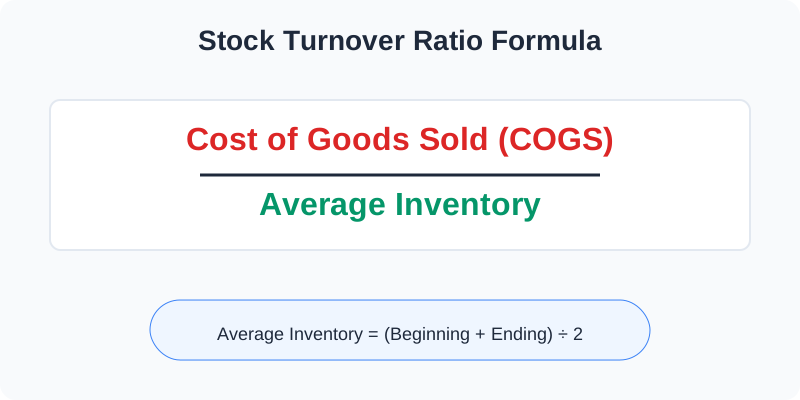
At its heart, the stock turnover ratio formula asks a simple question: "How many times did we sell out our inventory this year?"
Here is the formula I use:
Let's peel back the layers on those two components:
- Cost of Goods Sold (COGS): This is the total cost to produce or buy the goods you sold. Note that we rely on cost, not sales revenue. Using sales revenue (which includes your profit markup) would distort the ratio. We want to compare apples to apples—cost to cost.
- Average Inventory: Inventory levels fluctuate. You might be fully stocked in November and empty in January. To be fair, we take the average. usually calculated as
(Beginning Inventory + Ending Inventory) / 2.
Why "Average" Inventory?
I often get asked, "Why can't I just use my current inventory?" Imagine you take a snapshot of your warehouse on a day when a huge shipment just arrived. Your inventory would look huge, and your turnover ratio would look artificially low. Conversely, if you measure it on a day you're sold out, your ratio looks skyrocketingly high.
Using the Average Inventory irons out these spikes and dips, giving you a smooth, reliable trend line.
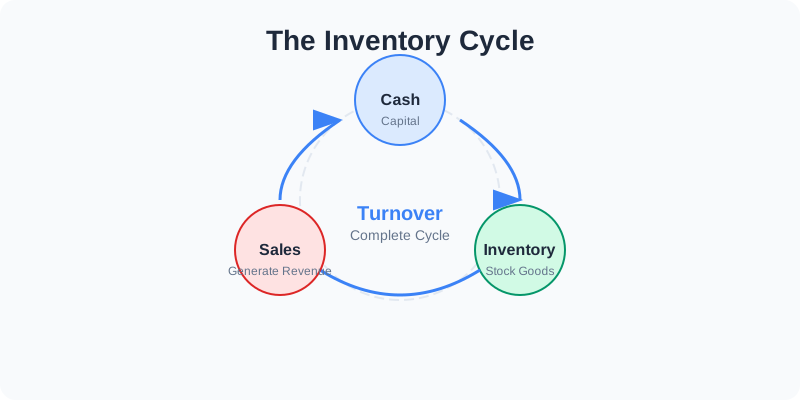
A Real-World Example
Let me walk you through an example. Let's say we are looking at a local coffee roastery.
- Cost of Goods Sold (Annual): $200,000
- Inventory at Start of Year: $15,000
- Inventory at End of Year: $25,000
First, we calculate the Average Inventory:
Now, we apply the main formula:
This tells me that the roastery sold through its entire stock of beans 10 times in that year. That's almost once every 5 weeks! For a coffee business where freshness is key, that's a pretty healthy number.
Interpreting Your Results
So, you've crunched the numbers and got a result. Is it good? Is it bad?
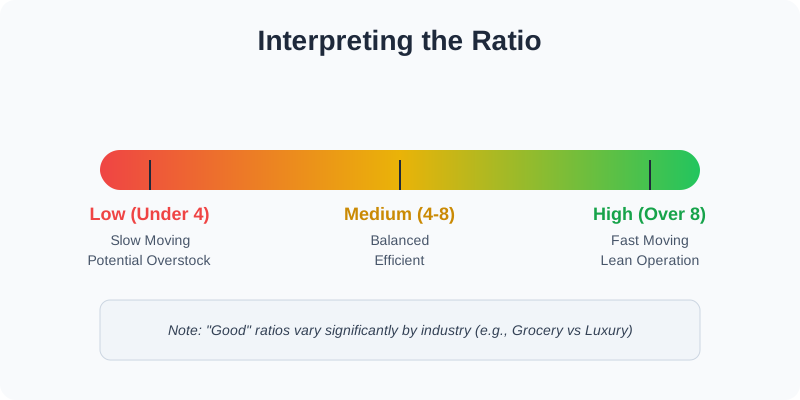
If your ratio is Low (e.g., 2-4): Use caution. It might mean you have too much cash tied up in boxes sitting on shelves. Are you ordering too much? Are your products not appealing to customers?
If your ratio is High (e.g., 10+): You're efficient! But be careful—you might be flying too close to the sun. If you run too lean, a single supply chain hiccup could leave you with empty shelves and angry customers.
Conclusion
Mastering the stock turnover ratio formula isn't just an accounting exercise; it's a strategic tool. By keeping an eye on this metric, I've seen business owners free up tens of thousands of dollars in cash flow just by adjusting their purchasing habits.
Now it's your turn. Dig out those financial statements, plug in the numbers, and see how efficiently your business is really running!
Frequently Asked Questions
What is the simplest way to remember the stock turnover ratio formula?
+I always tell people to think of it as 'Flow over Fund'. You take the flow of goods (Cost of Goods Sold) and divide it by the fund tied up in them (Average Inventory). It's simply measuring how many times your 'fund' cycles through the 'flow' in a year.
Can I use End-of-Year Inventory instead of Average Inventory?
+Technically, yes, but I wouldn't recommend it. Using just the end-of-year number can be misleading, especially if you have seasonal businesses. For example, if you run a toy store and measure inventory on December 31st, it might be very low, artificially inflating your turnover ratio. Averaging the start and end of the year gives you a much fairer picture.
Is a higher stock turnover ratio always better?
+Not necessarily! While we usually aim for higher efficiency, a ratio that's *too* high might mean you're understocking. I've seen businesses lose sales because they were so obsessed with keeping inventory low that they ran out of popular items. It's about finding that 'Goldilocks' zone—not too high, not too low.
How does the formula differ for a manufacturing company?
+The core concept remains the same, but the 'Inventory' part gets a bit more complex. For a manufacturer, Average Inventory includes raw materials, work-in-progress (WIP), and finished goods. If you're just looking at finished goods turnover, make sure your COGS matches that specific stage of production.
Where do I find these numbers on my financial statements?
+Grab your Income Statement for the 'Cost of Goods Sold' (COGS)—it's usually right at the top under Revenue. For Inventory, look at your Balance Sheet. You'll need the inventory number from the start of the period (Previous Year's Ending Inventory) and the end of the current period.