
What is Stock Turnover and Why Calculate It?
Stock turnover, also called inventory turnover ratio, tells you how many times your business has sold and replaced its inventory during a specific period—usually a year. Think of it as measuring the "velocity" of your inventory: how fast products move from your warehouse to customers' hands.
Calculating this ratio helps you understand whether you're managing inventory efficiently or if cash is sitting idle in unsold products. A well-calculated stock turnover ratio can reveal opportunities to improve cash flow, reduce storage costs, and optimize your purchasing decisions.
The Basic Formula: Breaking It Down
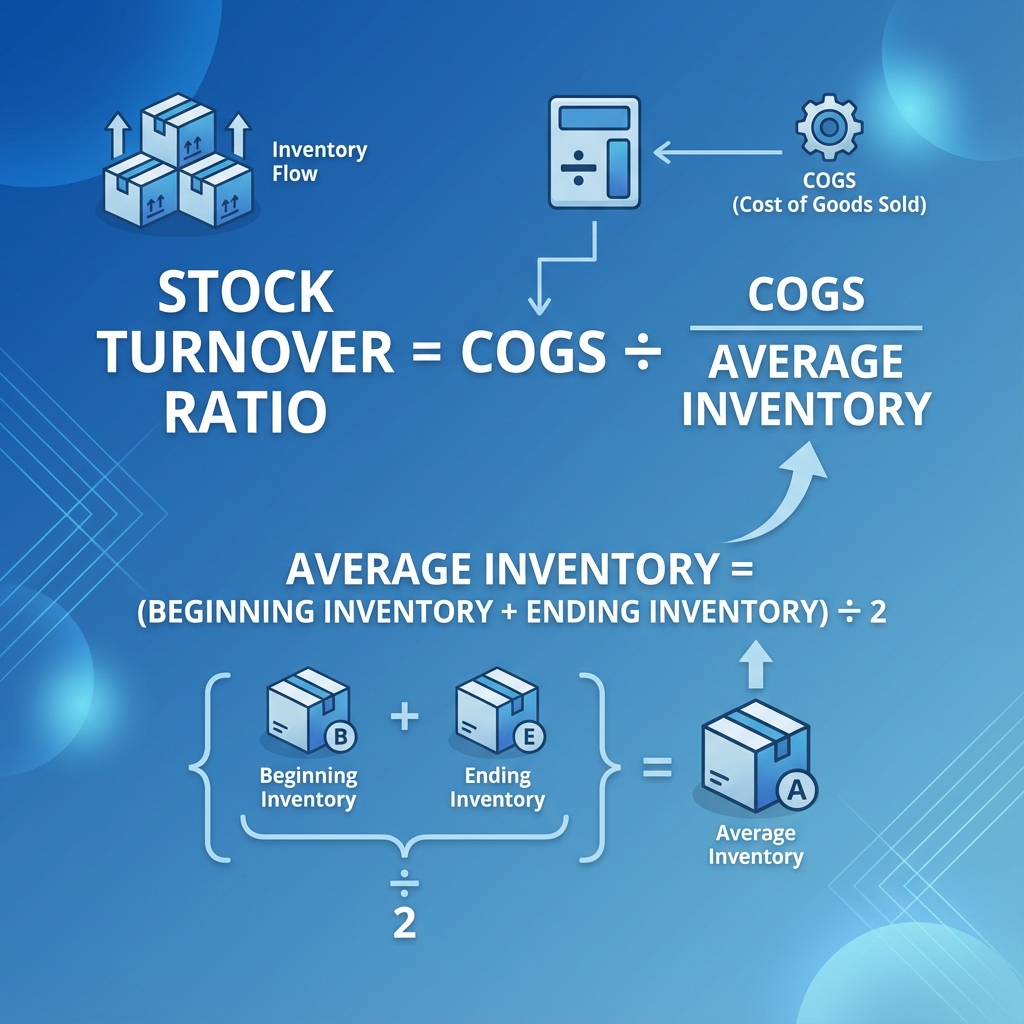
At its core, calculating stock turnover is straightforward. You need just two numbers from your financial statements:
Let's break down what each component means and where to find it:
1. Cost of Goods Sold (COGS)
COGS represents the direct costs of producing or purchasing the products you sold during the period. This includes:
- Raw materials: The actual materials used to make your products
- Direct labor: Wages paid to workers who manufacture the products
- Manufacturing overhead: Factory costs directly tied to production
Where to find it: Look at your income statement (also called profit and loss statement). COGS appears near the top, right after revenue. For publicly traded companies, you'll find this in their 10-K annual reports filed with the SEC.
2. Average Inventory
Your inventory value fluctuates throughout the year—it might spike before the holiday season and drop afterward. Using an average smooths out these fluctuations to give you a more accurate picture.
Where to find it: Check your balance sheet for inventory values. You'll need the inventory value at the start of your period (beginning inventory) and at the end (ending inventory).
Step-by-Step Calculation Guide
Let's walk through the calculation process with a practical example. Imagine you run a retail electronics store.
Step 1: Gather Your Numbers
From your financial statements for the year:
- Cost of Goods Sold (COGS): $600,000
- Beginning Inventory (January 1): $80,000
- Ending Inventory (December 31): $120,000
Step 2: Calculate Average Inventory
First, find the average of your beginning and ending inventory:
Step 3: Calculate the Stock Turnover Ratio
Now divide COGS by your average inventory:
Step 4: Interpret the Result
A ratio of 6 means you completely sold and replaced your inventory 6 times during the year. In other words, every two months on average, you cycled through your entire stock.
Converting to Days: How Long Does Inventory Sit?
Sometimes it's more intuitive to think in terms of days rather than a ratio. This metric is called Days Sales of Inventory (DSI) or Days Inventory Outstanding (DIO).
Using our example:
This means it takes approximately 61 days for your inventory to sell. The lower this number, the faster your inventory moves—which generally means better cash flow and lower storage costs.
Real-World Example: Comparing Two Businesses
Let's compare two hypothetical businesses to see how stock turnover reveals different operational strategies:
Example A: Fresh Grocery Store
- COGS: $2,000,000
- Average Inventory: $150,000
- Stock Turnover Ratio: $2,000,000 ÷ $150,000 = 13.3
- Days Sales of Inventory: 365 ÷ 13.3 = 27 days
Interpretation: The grocery store turns over inventory every 27 days, which makes sense for perishable goods. High turnover is essential to prevent spoilage.
Example B: Luxury Furniture Store
- COGS: $800,000
- Average Inventory: $400,000
- Stock Turnover Ratio: $800,000 ÷ $400,000 = 2
- Days Sales of Inventory: 365 ÷ 2 = 183 days
Interpretation: The furniture store's inventory sits for about 6 months. This isn't necessarily bad—luxury items with high margins can afford slower turnover. The key is comparing against industry benchmarks.
Common Mistakes to Avoid
When calculating stock turnover, watch out for these frequent errors:
Mistake #1: Using Sales Revenue Instead of COGS
The Problem: Some people mistakenly use total sales revenue in the numerator instead of COGS. This inflates the ratio because sales include your profit margin.
Why It Matters: Inventory on your balance sheet is recorded at cost (what you paid for it), not at selling price. To compare apples to apples, you must use COGS, which also reflects cost.
✅ Correct: COGS ÷ Average Inventory
Mistake #2: Using Only Ending Inventory
The Problem: Taking a single snapshot of inventory (like just the ending balance) can be misleading if your business has seasonal fluctuations.
The Solution: Always use average inventory. For even more accuracy, some businesses calculate a monthly average using all 12 months of inventory data, but the simple two-point average (beginning + ending ÷ 2) works well for most purposes.
Mistake #3: Ignoring Industry Context
The Problem: Assuming there's a universal "good" ratio. A ratio of 10 might be excellent for a furniture store but terrible for a grocery store.
The Solution: Always compare your ratio against industry benchmarks. Check what's typical for businesses similar to yours.
Mistake #4: Mixing Time Periods
The Problem: Using annual COGS but quarterly inventory values, or vice versa.
The Solution: Make sure your COGS and inventory values cover the same time period. If you're calculating for a year, use annual COGS and inventory values from the start and end of that year.
What Does Your Ratio Actually Tell You?
Once you've calculated your stock turnover ratio, here's how to interpret it:
High Turnover Ratio (8+)
What it means: Your inventory moves quickly. You're selling products fast and restocking frequently.
Potential benefits:
- Less cash tied up in inventory
- Lower storage and insurance costs
- Reduced risk of obsolescence or spoilage
- Better cash flow for growth or debt payment
Potential risks:
- Risk of stockouts if demand spikes unexpectedly
- May miss bulk purchasing discounts
- Higher ordering and shipping costs from frequent restocking
Medium Turnover Ratio (4-7)
What it means: You're maintaining a balanced approach—enough inventory to meet demand without excessive holding costs.
This is typical for many general retailers and manufacturers with steady, predictable demand.
Low Turnover Ratio (Below 4)
What it means: Inventory sits for a long time before selling.
Potential issues:
- Overstocking—you're buying more than you can sell
- Weak sales or poor product-market fit
- Cash tied up that could be used elsewhere
- Higher risk of products becoming obsolete or outdated
- Increased storage, insurance, and maintenance costs
When it's okay: Some industries naturally have low turnover. Luxury goods, heavy machinery, and custom furniture often have ratios below 4 because they have high margins and long sales cycles.
Industry Benchmarks: Where Do You Stand?
To truly understand your stock turnover ratio, you need context. Here are typical ranges for different industries:
- Grocery Stores: 10-20 (perishables can be 30-70)
- Restaurants: 15-30
- Consumer Electronics: 8-15
- Automotive Parts: 15-20
- Clothing Retail: 4-6
- Furniture Stores: 2-4
- Jewelry Stores: 1-3
- Manufacturing (General): 5-10
Pro tip: Look up your specific competitors' ratios if they're publicly traded. Their 10-K reports filed with the SEC contain all the data you need to calculate their ratios and compare.
Tips for Improving Your Stock Turnover Ratio
If your ratio is lower than you'd like, here are practical strategies to improve it:
1. Improve Demand Forecasting
Use historical sales data, market trends, and seasonal patterns to predict what you'll actually sell. Better forecasting means ordering the right quantities at the right time.
2. Optimize Pricing Strategy
If certain products sit too long, consider strategic discounts or promotions to move them faster. Dynamic pricing can help you respond to demand in real-time.
3. Clear Out Deadstock
Identify slow-moving or obsolete inventory and run clearance sales, bundle deals, or donate items for tax deductions. Freeing up capital and warehouse space is often worth taking a small loss.
4. Implement Just-In-Time (JIT) Inventory
Order inventory closer to when you actually need it rather than stockpiling. This requires reliable suppliers but can dramatically improve turnover.
5. Negotiate Better Supplier Terms
Work with suppliers to reduce minimum order quantities or improve delivery times. This lets you order smaller amounts more frequently.
6. Analyze Product Performance
Calculate turnover ratios for individual product categories or SKUs. Double down on fast-movers and reconsider slow-movers.
7. Improve Marketing and Sales
Sometimes the issue isn't inventory management—it's that products aren't selling fast enough. Invest in marketing, improve product descriptions, or enhance the customer experience.
Frequently Asked Questions
Q: Should I calculate stock turnover monthly, quarterly, or annually?
A: Most businesses calculate it annually for consistency with financial reporting. However, if you have seasonal fluctuations or want to track improvements, quarterly calculations can provide more timely insights. Just make sure to annualize your COGS (multiply quarterly COGS by 4) for fair comparison.
Q: What if my business is brand new and I don't have beginning inventory?
A: For your first period, you can use your ending inventory as a proxy for average inventory, or wait until you have at least two data points. Your first calculation won't be as accurate, but it will improve over time.
Q: Can stock turnover be too high?
A: Yes! An extremely high ratio might indicate you're running too lean and risking stockouts, which can lead to lost sales and frustrated customers. It might also mean you're missing out on bulk purchasing discounts. Balance is key.
Q: How does stock turnover relate to profitability?
A: Higher turnover doesn't automatically mean higher profits. A luxury jeweler might have a ratio of 2 but enjoy 300% margins, while a grocery store with a ratio of 15 might operate on 2-3% margins. Consider both turnover and profit margins together.
Q: Where can I find COGS and inventory data for my business?
A: Check your accounting software or financial statements. COGS is on your income statement, and inventory values are on your balance sheet. If you use QuickBooks, Xero, or similar software, these reports are typically just a few clicks away.
Ready to Calculate Your Stock Turnover?
Now that you understand how to calculate stock turnover ratio, you can use this knowledge to make smarter inventory decisions. Whether you're trying to improve cash flow, reduce storage costs, or optimize your purchasing strategy, this metric is a powerful tool.
Want to calculate your ratio instantly?
Use our free Stock Turnover Ratio Calculator to get your results in seconds. Just enter your COGS and inventory values, and we'll do the math for you—plus show you how you compare to industry benchmarks.
Key Takeaways
- Stock turnover ratio = COGS ÷ Average Inventory
- Always use COGS (not sales revenue) for accurate calculations
- Calculate average inventory using (Beginning + Ending) ÷ 2
- Compare your ratio against industry benchmarks, not universal standards
- High turnover means fast-moving inventory; low turnover may indicate overstocking
- Convert to days (365 ÷ ratio) for easier interpretation
- Monitor the ratio regularly to spot trends and opportunities
References: Financial data for calculating stock turnover ratios can be found in companies' income statements (for COGS) and balance sheets (for inventory values). Public companies file these with the U.S. Securities and Exchange Commission (SEC) in their 10-K and 10-Q reports, available at SEC.gov.