
Stock Turnover Ratio Calculator
Stock Turnover Ratio Calculator in 3 Simple Steps
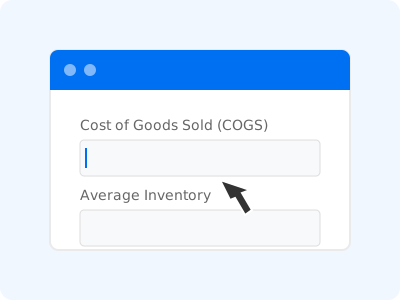
1. Input Data
Enter your Cost of Goods Sold (COGS) and Inventory values from your financial statements.
2. Calculate
Click the calculate button. Our tool automatically computes your Stock Turnover Ratio and Days Sales of Inventory.

3. Analyze
Compare your ratio with industry benchmarks to evaluate your inventory efficiency and make data-driven decisions.
What is Stock Turnover Ratio(STR)?
The stock turnover ratio, also known as inventory turnover ratio, is a key efficiency metric that measures how many times a company has sold and replaced its inventory during a specific period. It is a crucial indicator of how well a company manages its stock and generates sales from it.
A higher ratio generally implies strong sales or efficient inventory management, while a lower ratio may indicate weak sales, overstocking, or slow-moving inventory that ties up capital. This metric is widely used by investors, analysts, and business managers to evaluate operational efficiency.
How to Calculate Stock Turnover Ratio
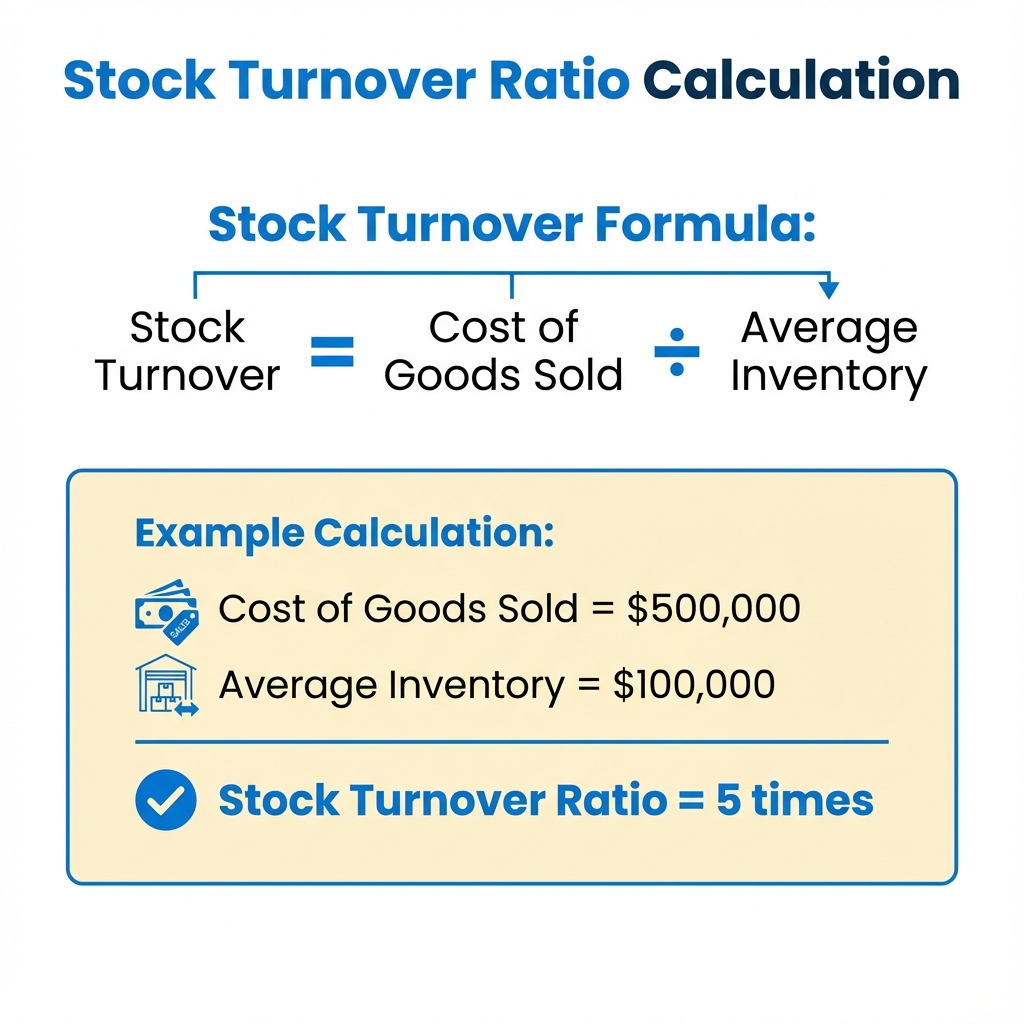
The formula for calculating the stock turnover ratio is straightforward:
To calculate the Average Inventory, use this formula:
Where:
- Cost of Goods Sold (COGS): The direct costs attributable to the production of the goods sold in a company. This figure appears on the income statement.
- Beginning Inventory: The value of inventory at the start of the accounting period.
- Ending Inventory: The value of inventory at the end of the accounting period. Both inventory values are found on the balance sheet.
Understanding Financial Statements
According to the U.S. Securities and Exchange Commission (SEC), public companies must file comprehensive financial statements that include the necessary data to calculate inventory turnover ratios. These statements include:
- Balance Sheet: Shows a company's assets, liabilities, and equity at a specific point in time, including inventory balances.
- Income Statement: Reports financial performance over an accounting period, including the Cost of Goods Sold (COGS).
While the SEC doesn't require companies to directly disclose the inventory turnover ratio, they must provide the underlying financial data in their 10-K (annual) and 10-Q (quarterly) reports. This allows investors and analysts to calculate the ratio themselves and assess a company's operational efficiency.
Example Calculation
Let's walk through a practical example to see how this works:
Suppose a retail company has a COGS of $500,000 for the year. At the beginning of the year, their inventory was worth $90,000, and at the end, it was $110,000.
- First, calculate Average Inventory: ($90,000 + $110,000) / 2 = $100,000.
- Then, divide COGS by Average Inventory: $500,000 / $100,000 = 5.
This means the company turned over its inventory 5 times during the year. In other words, they completely sold and replaced their stock five times over the 12-month period.
Stock Turnover Ratio Formula in Days
Sometimes, it's more intuitive to express this metric in days rather than as a ratio. This is often called Days Sales of Inventory (DSI) or Average Days to Sell Inventory. It tells you how many days it takes, on average, to sell your entire inventory.
Using our previous example where the Stock Turnover Ratio is 5:
This means it takes the company approximately 73 days to sell its inventory. A lower number of days generally indicates better efficiency, as cash is tied up in inventory for a shorter period.
What Does Your Ratio Mean?
Interpreting your stock turnover ratio depends on your industry and business model:
- High Ratio (6+): Indicates fast-moving inventory and efficient operations. Common in grocery stores, restaurants, and fashion retail where products have short shelf lives or seasonal demand.
- Medium Ratio (4-6): Suggests balanced inventory management. Typical for general retailers and manufacturers with steady demand.
- Low Ratio (Below 4): May indicate overstocking, slow sales, or products with long sales cycles. Common in luxury goods, furniture, or heavy machinery industries.
Remember, there's no universal "good" ratio—it varies significantly by industry. A car dealership might have a ratio of 2-3, while a supermarket might have 10-15.
Deep Dive: Low Stock Turnover
A low stock turnover ratio generally indicates that a company is holding onto inventory for too long. While this isn't always negative (as seen in high-margin luxury industries), it often signals underlying issues that need attention.
Common Causes
- Overstocking: Ordering more products than current demand justifies.
- Weak Sales: Ineffective marketing, poor product market fit, or economic downturns.
- Poor Inventory Management: Lack of visibility into stock levels leading to accumulation of obsolete items.
Potential Risks
- High Holding Costs: Storage fees, insurance, and maintenance costs eat into profits.
- Cash Flow Constraints: Capital tied up in unsold inventory cannot be used for growth or paying debts.
- Obsolescence: Products may become outdated, spoiled, or go out of fashion, leading to write-offs.
Industry Benchmark Data
To help you understand where your business stands, here are inventory turnover benchmarks across different industries based on data from publicly traded U.S. companies:
| Industry / Sector | Inventory Turnover Ratio |
|---|---|
| Retail - Food & Beverage | |
| Grocery Stores (Overall) | 15x |
| Perishable Goods (Baked Goods) | 69.5x |
| Fruit & Vegetable Markets | 29.1x |
| Gas Stations & Convenience Stores | 24-37x |
| Retail - General | |
| Retail Average | 9x |
| Automotive Parts | 15-20x |
| Consumer Electronics | 8-15x |
| Pharmacies | 12-15x |
| Home Improvement | 5-8x |
| Clothing & Accessories | 4-6x |
| Department Stores | 3-4x |
| Bookstores | 3-4x |
| Manufacturing | |
| Manufacturing (General) | 5-10x |
| Basic Materials | 5.02x |
| Capital Goods | 2.44x |
Note: These benchmarks are based on data from publicly traded U.S. companies. Your specific ratio may vary based on your business model, market conditions, and operational efficiency. Top-performing companies often achieve ratios 200-900% higher than industry averages.
Why is it Important?
Understanding your stock turnover ratio helps you make informed decisions about:
- Pricing Strategy: Identify if you need to adjust prices to move inventory faster.
- Purchasing Decisions: Determine optimal order quantities and timing.
- Cash Flow Management: Reduce capital tied up in slow-moving inventory.
- Storage Costs: Lower warehousing expenses by maintaining optimal inventory levels.
- Product Mix: Identify which products sell quickly and which don't.
By monitoring this ratio regularly, you can spot trends, compare your performance against competitors, and make data-driven decisions to improve profitability and operational efficiency.
Frequently Asked Questions
What is a good stock turnover ratio?
+A 'good' stock turnover ratio varies by industry. Generally, a ratio between 5 and 10 is considered healthy for most retail businesses. A high ratio implies strong sales or effective inventory management, while a low ratio may indicate overstocking or slow sales. However, grocery stores often have much higher ratios (10-15+), while luxury goods retailers may have lower ratios (2-4).
How do I calculate stock turnover ratio?
+The formula is: Stock Turnover Ratio = Cost of Goods Sold (COGS) / Average Inventory. Average Inventory is calculated as (Beginning Inventory + Ending Inventory) / 2. You can find these figures on your company's income statement and balance sheet.
Why use COGS instead of Sales Revenue?
+Using Sales Revenue would be misleading because it includes profit margins (markup). Inventory is recorded at cost. Dividing Sales (with profit) by Inventory (at cost) would inflate the ratio. To compare 'apples to apples', we must use the Cost of Goods Sold (COGS).
Why use 'Average' Inventory?
+Inventory levels can fluctuate significantly throughout the year due to seasonality or restocking cycles. Using a single snapshot (e.g., year-end inventory) might not reflect typical stock levels. Averaging the beginning and ending inventory provides a more accurate picture of the inventory held during the period.
What does the stock turnover number actually tell me?
+It measures the velocity of your inventory. If your ratio is 5, it means you sold and replaced your entire inventory 5 times during the period. It indicates how efficiently you are turning your capital (cash) into goods and back into cash.
What is the difference between inventory turnover and stock turnover?
+There is no difference; the terms are used interchangeably. Both refer to the same efficiency ratio measuring how many times inventory is sold and replaced over a period.
Related Guides
Tips to Improve Your Stock Turnover Ratio
- Optimize Pricing: Use dynamic pricing strategies to move slow-selling items.
- Improve Forecasting: Use historical data and market trends to predict demand more accurately.
- Reduce Lead Times: Work with suppliers to shorten delivery times and maintain lower inventory levels.
- Implement Just-In-Time (JIT): Order inventory only when needed to reduce holding costs.
- Clear Out Deadstock: Run promotions or discounts to eliminate obsolete inventory.
- Analyze Product Performance: Focus on high-turnover products and phase out slow movers.
Reference: Financial statement data required by the U.S. Securities and Exchange Commission (SEC) provides the foundation for calculating inventory turnover ratios. Public companies file detailed balance sheets and income statements in their 10-K and 10-Q reports, which are available on SEC.gov.