
Table of contents
Prorated Rent Calculator in 3 Simple Steps
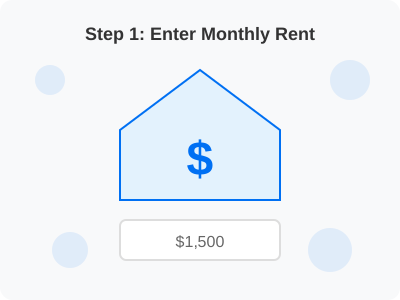
1. Enter Your Monthly Rent Amount
Input your agreed-upon monthly rent from your lease agreement. This is the base amount you\'d pay for a full month. Whether you\'re a tenant moving in or a landlord calculating partial month rent, start with your standard monthly rent figure.
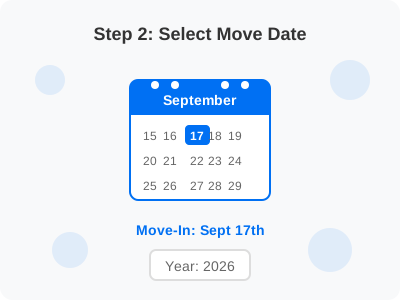
2. Select Your Move-In or Move-Out Date
Choose the year, month, and specific day you\'re moving in or out. Our calculator automatically accounts for the exact number of days in that month (including leap years for February). The day you move in or out counts as an occupied day.
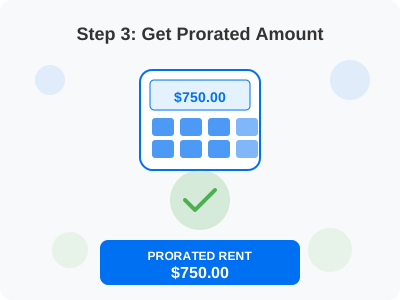
3. Get Your Prorated Rent Amount
Click calculate and instantly see your prorated rent, daily rate, and exact number of days you\'ll be charged. The result ensures you pay only for the days you\'ll actually occupy the property—fair and simple for everyone involved.
What is Prorated Rent?
I've been on both sides of rental agreements—as a tenant and as a landlord—and I can tell you that prorated rent is one of those concepts that seems technical but is actually just about fairness. It's the amount of rent you pay when you're only occupying a property for part of the month.
Here's the reality: Most leases start on the first of the month, but life doesn't always align with calendar dates. Jobs start mid-month, leases end on odd dates, and sometimes you just need flexibility. That's where prorated rent comes in. Instead of paying for an entire month you won't fully use, you pay a proportional amount based on the actual number of days you'll be living there.
I've seen prorated rent save tenants hundreds of dollars on move-in costs, and I've watched landlords fill vacancies faster by offering prorated rent. It's one of those win-win situations that makes rental agreements work better for everyone. When you're only paying for what you use, everybody wins.
Why I Always Prorate Rent
After years of rental experience, I've learned that prorated rent isn't just about math—it's about building trust and being reasonable. Here's why I'm such a strong advocate:
- It's fundamentally fair: Why should someone pay for days they don't have access to the property? When a tenant moves in on the 20th, charging them for the full month feels arbitrary and unfair. Prorating ensures they pay only for what they use.
- It fills vacancies faster: I've seen landlords lose great tenants because they insisted on full-month rent for a mid-month move-in. By offering prorated rent, you make your property more attractive and flexible. Tenants appreciate landlords who meet them halfway.
- It builds goodwill: Starting a landlord-tenant relationship with a fair prorated rent arrangement sets a positive tone. It shows you're reasonable and willing to work with your tenant. That goodwill pays off throughout the lease.
- It's standard practice: Most professional property management companies prorate rent. If you don't, you're going against industry norms and potential tenant expectations. Stand out by being the landlord who does things right.
- It prevents disputes: When prorated rent is clearly calculated and documented, there's no room for disagreement later. Everyone knows exactly what's owed and why.
How to Calculate Prorated Rent
The formula is straightforward, and I've walked countless people through it. Here's exactly how I calculate prorated rent:
Let me break down each component:
- Monthly Rent: The agreed-upon rent amount from your lease agreement for a full month.
- Total Days in Month: The actual number of days in that specific month (28, 29, 30, or 31). This is crucial—January has 31 days, February has 28 (or 29 in leap years), April has 30 days, and so on.
- Days Occupied: The number of days you'll actually be living in the property. For move-ins, count from your move-in day through the end of the month. For move-outs, count from the first of the month through your move-out day.
The Calculation Steps I Follow
- Find the daily rent: Divide the monthly rent by the total number of days in the month. This gives you the exact cost per day.
- Determine occupancy days: Count how many days you'll be in the property. Remember, your move-in or move-out day counts!
- Multiply: Multiply the daily rent by the number of days you'll occupy the property.
- That's it! The result is your fair, prorated rent amount.
Different Calculation Methods I've Encountered
In my experience, there are two main methods for calculating prorated rent. The standard method (which our calculator uses) is most common and fairest, but you should know about both:
Method 1: Actual Days in Month (Recommended)
This is the method I use and recommend. You divide the monthly rent by the actual number of days in that specific month:
For example, \$1,500 rent in January (31 days): \$1,500 ÷ 31 = \$48.39 per day. In February (28 days): \$1,500 ÷ 28 = \$53.57 per day. This method is precise and accounts for the varying lengths of different months.
Method 2: 30-Day Month (Simplified)
Some landlords use this simplified method, dividing by 30 regardless of the actual month length:
Using the same \$1,500 rent: \$1,500 ÷ 30 = \$50 per day (every month). This is easier to calculate but can be slightly unfair. In January (31 days), tenants overpay slightly. In February (28 days), they pay less than they should. If your landlord uses this method, it's typically disclosed in the lease.
My take: I prefer the actual-days method because it's mathematically fair. However, both methods are legal if disclosed in your lease. The key is consistency and transparency.
Move-In Example Calculation
Let me walk you through a real-world example. Suppose you're moving into a new apartment:
The scenario:
- Monthly rent: \$1,800
- Move-in date: September 17th
- Days in September: 30 days
The calculation:
- Daily rent: \$1,800 ÷ 30 = \$60.00 per day
- Days occupied: From September 17th through 30th = 15 days (including the 17th)
- Prorated rent: \$60.00 × 15 = \$900.00
Result: Your prorated rent for September would be \$900.00, instead of paying the full \$1,800. You save \$900 for the half-month you won't be there. This is fair to both you and your landlord—you pay for exactly 15 days of a 30-day month, which is precisely half the monthly rent.
Move-Out Example Calculation
Now let's look at a move-out scenario. Suppose you're leaving your apartment:
The scenario:
- Monthly rent: \$2,000
- Move-out date: March 20th
- Days in March: 31 days
The calculation:
- Daily rent: \$2,000 ÷ 31 = \$64.52 per day
- Days occupied: From March 1st through 20th = 20 days
- Prorated rent: \$64.52 × 20 = \$1,290.40
Result: Your prorated rent for March would be \$1,290.40, saving you \$709.60 compared to the full month's rent. This is particularly helpful when your lease end date doesn't align perfectly with the end of the month, which happens frequently.
When Should You Prorate Rent?
Through my experience, I've identified several scenarios where prorated rent is standard practice:
- Mid-month move-ins: The most common scenario. You're starting a lease on any day other than the first. Most landlords will prorate the first month's rent, making it easier for tenants to move in when convenient rather than waiting for the first of the month.
- Early move-outs: You're ending your lease before the last day of the month. Whether by mutual agreement or lease termination, prorating ensures you only pay for the days you're actually there.
- Lease transfers: When taking over someone else's lease mid-month, both the outgoing and incoming tenants may have prorated rent calculations.
- Temporary extensions: If you need to stay a few extra days after your lease ends, prorating calculates the fair additional amount.
- Month-to-month transitions: When switching from a lease to month-to-month, or vice versa, mid-month changes may require proration.
Legal Considerations I've Learned
Before I dive into tips, let me cover some important legal ground rules I've learned through experience:
- No federal requirement: Federal law doesn't mandate prorated rent. It's largely governed by state and local laws, plus your lease agreement.
- State laws vary: Some states have specific requirements or guidelines about prorated rent. California, for example, has detailed regulations. Always check your local laws.
- Lease agreement rules: Your lease is the controlling document. If it specifies whether and how rent is prorated, those terms typically prevail. If it's silent, you'll need to negotiate.
- Written agreements are crucial: I always recommend getting prorated rent terms in writing. Verbal agreements are difficult to enforce if disputes arise later.
- Consistency matters: If your landlord has prorated rent for other tenants, they may be legally required to offer the same to you under fair housing laws in some jurisdictions.
- Security deposits are separate: Prorated rent is separate from security deposits, which are typically governed by different rules and limits.
My advice: Always clarify prorated rent before signing a lease. If it's important to you, negotiate those terms upfront and include them in your written agreement. Once the lease is signed, you're bound by whatever terms are specified (or lack thereof).
My Tips for Landlords
Having worked with many landlords, here's what I recommend:
- Adopt a standard prorated rent policy:
Don't decide case-by-case. Have a clear, consistent policy for when and how you prorate rent. Document it and apply it consistently to all tenants. This prevents discrimination claims and ensures fair treatment.
- Include terms in your lease agreement:
Specify whether you prorate rent, the calculation method you use, and any conditions. For example: "Landlord shall prorate rent for mid-month move-ins using the actual-days-in-month method." Being explicit prevents confusion later.
- Use the actual-days method:
It's more precise and perceived as fairer. The 30-day method may seem arbitrary to tenants who notice they're paying slightly more in 31-day months. Accuracy builds trust.
- Provide written calculations:
When prorating rent, give tenants a written breakdown showing the calculation. Include the monthly rent, days in month, daily rate, days occupied, and final amount. Transparency prevents disputes.
- Be flexible on move-ins, cautious on move-outs:
Most landlords readily prorate for mid-month move-ins because it helps fill vacancies. However, some are more hesitant about move-outs, since tenants leaving early can create scheduling challenges. Decide your policy and stick to it.
- Track prorated rent separately:
For accounting purposes, clearly document prorated rent payments separately from regular monthly rent. This helps with bookkeeping and tax reporting.
My Advice for Tenants
As someone who's rented many times, here's my advice for tenants:
- Ask about prorated rent before signing:
Don't assume it will be offered. Ask specifically: "Do you prorate rent for mid-month move-ins and move-outs?" If the answer is yes, get the details in writing. If no, you can negotiate.
- Verify the calculation:
Landlords can make mistakes. Use our calculator above to verify the prorated amount they're quoting. If there's a discrepancy, politely ask for their calculation breakdown. Most errors are unintentional.
- Understand which method is used:
Ask whether they use the actual-days-in-month method or the 30-day method. The difference might be small, but it's good to know. If they use the 30-day method and you're moving in during a 31-day month, you're slightly overpaying.
- Get everything in writing:
Don't rely on verbal agreements about prorated rent. Ensure your lease agreement specifies the prorated amount for the first/last month, or the calculation method if the exact date isn't known yet.
- Know your rights:
Research your state and local laws regarding prorated rent. Some jurisdictions have specific requirements. If your landlord refuses to prorate when local law requires it, that's important leverage.
- Plan ahead:
If you know you'll be moving mid-month, start discussing prorated rent with your landlord well in advance. Last-minute negotiations are less likely to succeed. Give your landlord time to accommodate your request.
Common Mistakes I See People Make
In my years of rental experience, I've watched people make predictable errors with prorated rent. Here are the most common ones:
- Not counting the move-in/move-out day: This is the #1 mistake. If you move in on the 15th, that day counts! I've seen people miscalculate by one day repeatedly. Remember, your first day in the property is Day 1, not Day 0.
- Using the wrong number of days in the month: July has 31 days, not 30. February has 28 (or 29 in leap years), not 30. Using the wrong number throws off the entire calculation. Our calculator handles this automatically.
- Assuming all landlords prorate: Some don't, and they're not legally required to (in most areas). Don't wait until move-in day to discover prorated rent isn't offered. Clarify this upfront.
- Not getting terms in writing: Verbal agreements about prorated rent are difficult to enforce. If your landlord agrees to prorate, get that specific commitment in your lease agreement.
- Forgetting about February: February's shorter length means higher daily rates if the monthly rent is the same. Don't be surprised if prorated rent in February seems higher per day than other months.
- Confusing prorated rent with partial payments: Prorated rent is calculated proportionally based on the daily rate. It's not just "half the rent for half the month"—it's precisely calculated based on actual days.
- Negotiating after signing: Once you've signed a lease without prorated rent terms, you have little leverage to negotiate it later. Address this before signing.
My Final Thoughts
Prorated rent is one of those concepts that seems minor but has a significant impact on the landlord-tenant relationship. It's about more than just mathematics—it's about fairness, transparency, and mutual respect.
I've seen rental arrangements start on the wrong foot because landlords insisted on full-month rent for mid-month move-ins, and I've watched relationships flourish when both parties approached prorated rent reasonably and fairly. When tenants feel they're being treated fairly from day one, they're more likely to be good tenants who pay on time, take care of the property, and communicate openly.
For landlords, prorating rent isn't just about being nice—it's about being competitive and smart. In a rental market where tenants have choices, offering fair prorated rent policies can give you an edge. You'll fill vacancies faster, attract better tenants, and build a reputation as a reasonable landlord.
Use our free calculator above to calculate prorated rent instantly and accurately. Whether you're a tenant moving in, a tenant moving out, or a landlord managing properties, this tool ensures everyone gets a fair deal based on precise calculations, not guesswork.
Remember: the goal of prorated rent is fairness. It ensures tenants pay only for what they use and landlords receive fair compensation for the days their property is occupied. When both parties approach it with that mindset, rental agreements work better for everyone.
Frequently Asked Questions
What is prorated rent?
+Prorated rent is the amount a tenant pays when they occupy a rental property for only part of the month. Instead of paying the full month's rent, you pay a proportional amount based on the actual number of days you'll be living there. For example, if you move in on the 15th of a 30-day month, you'd pay half of the monthly rent. This ensures fair billing for both landlords and tenants.
How do I calculate prorated rent?
+The standard formula is: (Monthly Rent ÷ Total Days in Month) × Days Occupied = Prorated Rent. For example, if your monthly rent is $1,500, you move in on the 16th of a 31-day month, you'd occupy it for 16 days (including the 16th). Daily rent = $1,500 ÷ 31 = $48.39. Prorated rent = $48.39 × 16 = $774.24. Use our calculator above to automate this calculation instantly.
Are landlords required to prorate rent?
+There's no federal law requiring landlords to prorate rent. Whether rent is prorated depends on state and local laws, and most importantly, your lease agreement. Some states have specific requirements, while others leave it to landlord discretion. I always recommend including prorated rent terms in your lease agreement to avoid confusion. Check your local housing authority for specific regulations in your area.
When should I request prorated rent?
+You should request prorated rent whenever you're moving in on any day other than the first of the month, or moving out before the last day of the month. The most common scenarios include: mid-month move-ins (relocating for a job, personal circumstances), lease end dates that don't align with month-end, or extending your stay by a few days into the next month. Always discuss prorated rent before signing the lease.
What's the difference between prorated rent and partial rent?
+Prorated rent and partial rent essentially mean the same thing—rent that's adjusted for a partial month of occupancy. However, "prorated" specifically refers to a proportional calculation based on the daily rate, while "partial rent" is a more general term. Prorated rent is calculated using a specific formula (monthly rent ÷ days in month × days occupied), ensuring the amount is mathematically fair.
Do I count the move-in day in prorated rent?
+Yes, absolutely! The day you move in counts as your first day of occupancy. For example, if you move in on the 15th, that day is included in your calculation. If you move in on the 15th of a 30-day month, you'll be responsible for 16 days (the 15th through the 30th). This is standard practice because you have access to and use the property starting on your move-in day.
How is February handled in prorated rent calculations?
+February is calculated the same way as any other month—you use the actual number of days in that February (28 or 29 in a leap year). For example, if rent is $1,200 and you occupy the property for all 28 days of February, you'd pay the full $1,200. The daily rate would be $1,200 ÷ 28 = $42.86 per day. February's shorter length is already factored into the monthly rent amount, so no special adjustments are needed.
Can a landlord refuse to prorate rent?
+Yes, unless state or local law requires it or your lease agreement specifies prorated rent terms. Landlords generally have discretion to set their own policies. However, most reasonable landlords will prorate rent for mid-month move-ins because it's fair and helps fill vacancies faster. If prorated rent is important to you, negotiate it before signing the lease and include it in your written agreement.
Should prorated rent be included in the lease agreement?
+Definitely yes! I always recommend including the specific prorated rent amount and calculation method in the lease agreement. This prevents disputes and confusion later. The lease should state: the monthly rent, the move-in date, the prorated amount due for the first/last month, and the calculation method used. Once signed, this becomes legally binding and protects both parties.
What if my landlord uses a 30-day month for calculations?
+Some landlords use a simplified 30-day month calculation (Monthly Rent ÷ 30 × Days Occupied) regardless of the actual month length. This can slightly affect your prorated amount—sometimes in your favor, sometimes not. While the actual-days-in-month method is more common and precise, the 30-day method is legally acceptable if disclosed in your lease. Always clarify which method your landlord uses before agreeing.