
Let Me Give You the Straight Talk About Debtors Turnover Ratio
I've spent years analyzing financial metrics, and I can tell you that debtors turnover ratio is one of the most misunderstood yet crucial indicators of business health. It tells you something fundamental: how efficiently are you converting credit sales into actual cash?
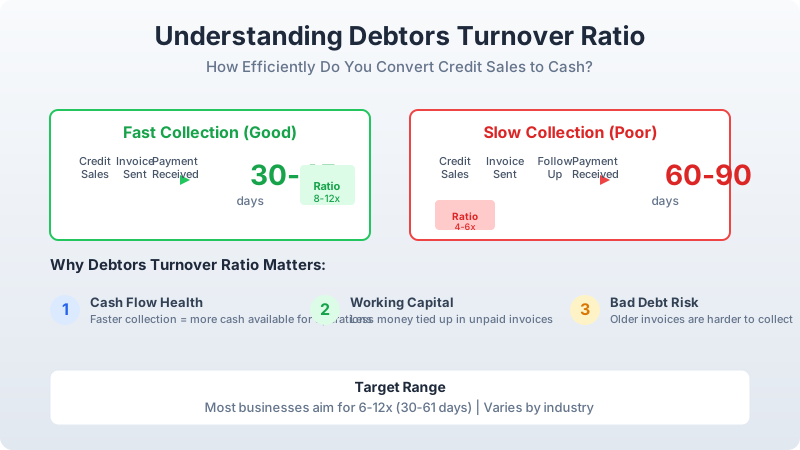
Here's the quick answer you're probably looking for: for most businesses, a good debtors turnover ratio falls between 6 and 12 times per year, which translates to collecting payments in 30-61 days. But—and this is a big but—like all financial metrics, context is everything. A B2B manufacturer operating at 8x might be crushing their industry average, while a retailer at 10x could be underperforming.
I'm going to walk you through everything I know about debtors turnover ratio: what it is, how to calculate it (including the debtors turnover ratio formula in days), what is a good debtors turnover ratio for your industry, and most importantly, how to improve it. This isn't just theory—I've used these strategies to help businesses dramatically improve their cash flow.
What Exactly Is Debtors Turnover Ratio?
Let me break this down in simple terms. Debtors turnover ratio (also called accounts receivable turnover ratio) measures how many times per year your business collects its average accounts receivable balance. It's a velocity metric—higher is generally better because it means you're converting credit sales into cash faster.
Think of it this way: if you have $100,000 in average accounts receivable and you make $600,000 in credit sales per year, your debtors turnover ratio is 6. You're "turning over" your receivables 6 times annually. Every 60 days, on average, you're collecting what your customers owe you.
Why this matters: Sales on credit look great on your income statement, but they don't pay the bills. Cash does. Debtors turnover ratio bridges the gap between making sales and actually having money in the bank. I've seen profitable businesses fail because they couldn't collect fast enough, and I've seen businesses with modest margins thrive because they were collection machines.
The Debtors Turnover Ratio Formula (Two Ways to Calculate)
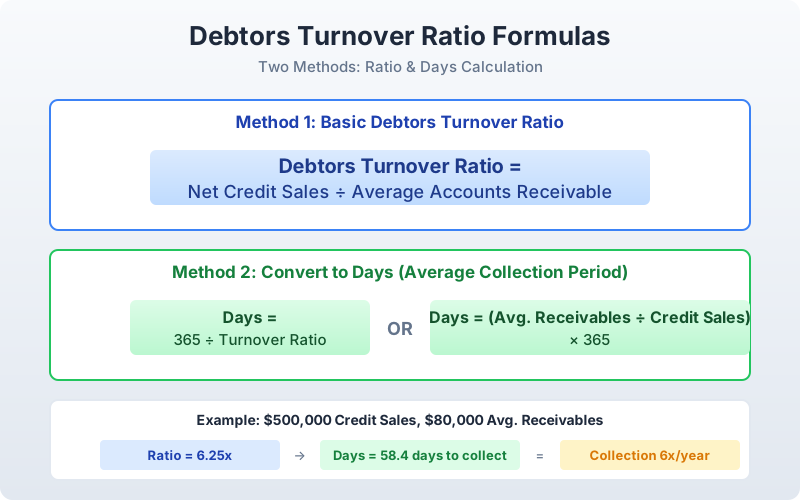
I'll show you two ways to calculate this. The first is the basic ratio, and the second converts it to days—which most people find more intuitive.
Method 1: Basic Ratio Calculation
Let me explain each component:
- Net Credit Sales: Total sales made on credit during the period, minus returns and allowances. Don't include cash sales—they don't create receivables.
- Average Accounts Receivable: (Beginning Accounts Receivable + Ending Accounts Receivable) ÷ 2. If you have monthly data, you can use a more sophisticated average, but the simple version works for most businesses.
Example Calculation
Let's say your business has:
- Net Credit Sales: $500,000 per year
- Beginning Accounts Receivable: $70,000
- Ending Accounts Receivable: $90,000
Your Average Accounts Receivable = ($70,000 + $90,000) ÷ 2 = $80,000
Debtors Turnover Ratio = $500,000 ÷ $80,000 = 6.25
You're collecting your average receivables 6.25 times per year.
Method 2: Debtors Turnover Ratio Formula in Days
This is what most business owners find more practical. Instead of an abstract ratio, you get a concrete number of days it takes to collect payment.
Or you can calculate directly:
Using our example above:
Average Collection Period = 365 ÷ 6.25 = 58.4 days
On average, it takes you about 58 days to collect payment from customers who bought on credit.
What Is a Good Debtors Turnover Ratio?
I know you want a specific target number, and I'll give you ranges. But I need you to understand something crucial: what's "good" depends entirely on your industry, business model, and credit policies. A ratio that's exceptional for a manufacturer might be problematic for a retailer.
General Guidelines Across Industries
Based on my analysis of financial data across sectors, here are typical ranges:
High Turnover Industries (10-18+ times per year)
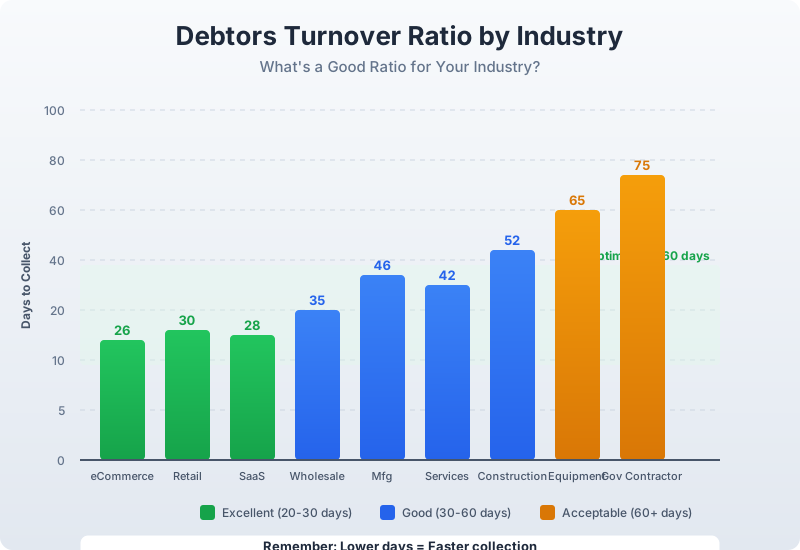
- Retail (with credit sales): 10-15x (24-36 days)—retailers often have faster collection because many sales are cash or card
- eCommerce: 12-18x (20-30 days)—online payment processing accelerates collection
- Wholesale distribution: 10-14x (26-36 days)—high volume, tighter credit terms
Medium Turnover Industries (6-12 times per year)
- Manufacturing: 6-10x (36-61 days)—B2B customers with 30-60 day payment terms
- Professional services: 7-11x (33-52 days)—service-based billing cycles
- Technology (SaaS): 8-12x (30-46 days)—subscription models with predictable billing
- Construction: 6-9x (40-61 days)—progress billing and retainage common
Lower Turnover Industries (4-8 times per year)
- Heavy equipment/machinery: 4-7x (52-91 days)—large orders, extended payment terms
- Government contractors: 4-6x (61-91 days)—bureaucratic payment processes
- Commercial real estate: 4-8x (45-91 days)—lease structures vary widely
How to Interpret Your Debtors Turnover Ratio
Now that you have your number, what's it actually telling you? Let me break down what different ratios mean for your business.
High Ratio (10+): Highly Efficient or Overly Restrictive?
If your debtors turnover ratio is 10 or higher, you're collecting payments quickly—on average, every 36 days or less. This generally indicates excellent collection efficiency, but it warrants closer examination.
The good news: You have minimal capital tied up in accounts receivable, your cash flow is strong, and you're less dependent on external financing. Your working capital is available for growth, not sitting in unpaid invoices.
The question to ask: Are your credit policies too strict? I've seen businesses with impressive turnover ratios that were leaving sales on the table because competitors offered more attractive payment terms. If you're in a competitive industry and customers frequently ask for longer payment terms, your high ratio might actually be a competitive disadvantage.
Medium Ratio (6-9): Healthy and Balanced
In my experience, ratios between 6 and 9 represent healthy collection performance for most B2B businesses. You're collecting in 40-61 days on average, which aligns with typical 30-60 day credit terms. This range suggests you've found the right balance between extending credit to support sales and collecting efficiently to maintain cash flow.
This is the sweet spot for many businesses—competitive credit policies that customers accept, combined with effective collection processes that keep cash moving.
Low Ratio (Below 6): Time for Action
If your debtors turnover ratio is below 6 (collecting in more than 61 days), and you're not in a low-turnover industry like government contracting, you likely have collection inefficiencies that need attention.
The problems this creates: Your cash is tied up in unpaid invoices, forcing you to borrow money (paying interest) or miss growth opportunities. You're at higher risk of bad debts—older invoices are harder to collect. Your working capital is unnecessarily constrained.
Common causes I see: Lenient credit policies with no clear criteria, ineffective invoicing processes (slow or inaccurate invoices), lack of proactive collection follow-up, customers with financial problems paying late, or simply not prioritizing accounts receivable management.
Industry Benchmarks: What's Realistic for Your Business?
Let me give you specific benchmarks so you can compare intelligently. These are based on publicly traded company data and industry analysis.
Manufacturing Industry Debtors Turnover
Manufacturing typically has slower turnover due to B2B payment cycles:
- Food & Beverage Manufacturing: 8-12x (30-46 days)—faster turnover due to perishable goods
- Chemical Manufacturing: 7-10x (36-52 days)—stable industrial demand
- Machinery Manufacturing: 5-8x (45-73 days)—larger orders, longer terms
- Electronics Manufacturing: 9-13x (28-40 days)—faster product cycles drive efficiency
Retail and Wholesale Benchmarks
Retail and wholesale tend to have faster collection due to payment processing:
- General Retail: 10-15x (24-36 days)—mix of cash, card, and store credit
- Wholesale Distribution: 9-13x (28-40 days)—volume-driven efficiency
- Fashion Retail: 11-16x (23-33 days)—seasonal inventory demands fast cash conversion
Service Industry Benchmarks
Service businesses vary widely based on billing models:
- Professional Services (legal, consulting): 7-11x (33-52 days)—hourly billing and retainers
- Software/SaaS: 10-14x (26-36 days)—subscription billing creates predictability
- Construction: 5-8x (45-73 days)—progress billing and retainage slow collection
Proven Strategies to Improve Your Debtors Turnover Ratio
I've helped dozens of businesses improve their debtors turnover ratio, and I want to share what actually works. These aren't theoretical suggestions—these are practical, implementable strategies that drive real results.
1. Tighten Your Credit Policy (Strategically)
Many businesses extend credit too liberally without clear criteria. I recommend establishing a formal credit policy that defines: minimum credit score requirements, maximum credit limits by customer tier, standard payment terms (net 30 is typical), and circumstances requiring deposits or advance payments. The goal isn't to eliminate credit sales—it's to extend credit wisely to customers who will pay on time.
2. Invoice Immediately and Accurately
This sounds obvious, but I can't tell you how many businesses delay invoicing or send invoices with errors. Every day you delay invoicing is another day added to your collection period. Automate invoice generation immediately upon delivery or service completion. Double-check accuracy—disputes over invoice errors are a major cause of payment delays. Include clear payment instructions, due dates, and late payment terms.
3. Offer Early Payment Discounts
One of the most effective tools I've used is offering early payment discounts, typically structured as "2/10 net 30"—customers get a 2% discount if they pay within 10 days, otherwise full payment is due in 30 days. For many customers, 2% is free money (they'd earn far less keeping cash in the bank), so they pay early. You're effectively paying 2% to accelerate cash collection by 20 days—calculate whether this makes sense for your margins.
4. Implement Automated Payment Reminders
Don't rely on memory or manual processes. Set up automated email reminders: one before the invoice is due (e.g., 5 days prior), one on the due date, and a series after the due date (3 days past due, 10 days past due, 20 days past due). Make them polite but firm. Automation ensures consistency and prevents invoices from slipping through the cracks. I've seen businesses reduce average collection time by 10+ days just by implementing automated reminders.
5. Regularly Review Your Accounts Receivable Aging Report
Your aging report is your collection radar. Review it weekly, not monthly. Identify which customers are consistently late and reach out personally. Sometimes a phone call uncovering issues (invoices going to the wrong person, simple oversights, cash flow problems) resolves the problem quickly. For chronically late customers, consider placing them on credit hold or requiring COD for future orders until their account is current.
6. Offer Multiple Payment Options
Make it easy for customers to pay you. Accept credit cards, ACH transfers, electronic checks, and digital payment platforms. Credit cards typically cost you 2-3% in processing fees, but if that accelerates collection by 30 days, it might be worth it—calculate your cost of capital to compare. The easier you make payment, the faster you'll get paid.
7. Require Deposits for Large Orders or New Customers
For new customers without established credit history, or for unusually large orders, require a deposit upfront (typically 30-50%) with the balance due on delivery or net 30. This reduces your risk and ensures some cash flows early. As customers establish a payment history, you can extend more favorable terms.
8. Conduct Credit Checks on Significant Customers
Before extending substantial credit, check the customer's creditworthiness. Use business credit reporting services or ask for trade references. I've avoided many bad debts by discovering red flags upfront—a history of slow payment to other vendors, declining credit scores, or legal judgments. It's not personal; it's business.
9. Train Your Sales Team on Credit Implications
Sales teams are incentivized to close deals, sometimes at the expense of credit quality. Ensure they understand that a sale isn't complete until the money is collected. Tie commission structures to collected revenue, not just booked revenue. I've seen this simple change dramatically reduce sales to high-risk customers.
10. Consider Factoring for Chronic Cash Flow Gaps
If you're consistently collecting slowly and need faster cash, factoring might be an option. You sell your receivables to a factoring company at a discount (typically 2-5%) and receive immediate cash. It's not ideal—you're giving up margin—but if it enables growth or prevents cash flow crises, it might make sense. Use it strategically, not as a permanent crutch.
Real-World Impact: How Better Collection Transforms Businesses
Let me share two examples from my advisory work to illustrate the power of improving debtors turnover ratio.
Example 1: The Manufacturing Turnaround
A mid-sized manufacturer came to me with a debtors turnover ratio of 4.2 (87-day collection period) and chronic cash flow problems. They were constantly borrowing to cover payroll and suppliers, paying significant interest. We implemented several strategies: credit policy formalization, automated invoicing and reminders, early payment discounts, and weekly aging report reviews with direct follow-up on overdue accounts.
Within 8 months, their ratio improved to 7.1 (51-day collection period). This freed up approximately $180,000 in cash that had been tied up in receivables. Their borrowing costs dropped by $15,000 annually, and they had the cash to take advantage of supplier early payment discounts, saving another $8,000. The transformation was dramatic, and it all started with focusing on collections.
Example 2: The Service Business Optimization
A B2B service company had a decent ratio of 8.5 (43-day collection period) but wanted to optimize further. We analyzed their customer base and discovered that 20% of customers accounted for 70% of late payments. They restructured payment terms for these customers, requiring 50% upfront with progress billing for the balance. For the remaining 80% of good customers, they maintained net 30 terms to preserve relationships.
Their overall ratio improved to 10.2 (36-day collection period). More importantly, they reduced bad debt write-offs by 65% and improved customer satisfaction by addressing payment issues upfront instead of after services were delivered. Sometimes targeted optimization beats across-the-board changes.
The Connection Between Debtors Turnover and Other Financial Metrics
Debtors turnover ratio doesn't exist in isolation—it connects to other important financial metrics. Understanding these relationships helps you manage your overall financial health.
Debtors Turnover and Cash Conversion Cycle
The cash conversion cycle measures how long it takes to convert inventory and receivables into cash. Debtors turnover is a key component: shorter collection periods reduce your cash conversion cycle, freeing up cash faster. If your competitors have shorter cycles, they can reinvest cash faster, creating a competitive advantage.
Debtors Turnover and Working Capital
Accounts receivable represents a significant investment of working capital. Higher turnover ratios reduce the working capital tied up in receivables, making capital available for inventory, equipment, or growth initiatives. I've calculated that reducing collection time by just 10 days for a $5 million credit sales business frees up approximately $137,000 in working capital ($5M × 10/365).
Debtors Turnover and Profitability
Better collection directly impacts profitability in several ways: reduced interest expenses on borrowing (since you need less external financing), fewer bad debt write-offs (older invoices are less likely to be collected), and potential early payment discounts from suppliers (when you have cash on hand). Collection efficiency isn't just about speed—it's about profitability.
Common Mistakes I See Businesses Make
After years of analyzing financial operations, I've identified recurring mistakes that hurt debtors turnover ratios. Avoid these pitfalls:
Mistake 1: Inconsistent Credit Policies
Salespeople extending different terms to different customers without clear guidelines. This creates chaos, makes collection unpredictable, and trains customers to negotiate payment terms. Establish a formal credit policy and enforce it consistently.
Mistake 2: Delayed Invoicing
Waiting until the end of the month to batch invoices instead of invoicing immediately upon delivery or service completion. Every day of delay adds to your collection period. Automate invoicing to eliminate this bottleneck.
Mistake 3: Ignoring Aging Reports Until Month-End
The problem with reviewing aging reports monthly is that by the time you identify a problem, invoices are already 30+ days old. Review weekly and act immediately on overdue accounts. Early intervention dramatically increases collection success.
Mistake 4: Accepting Late Payments Without Consequence
If customers learn there are no consequences for late payment, they'll prioritize other vendors. You don't have to be aggressive, but you do need to be consistent. Implement late fees, place accounts on credit hold, or stop extending credit to chronically late customers.
Mistake 5: Not Training Frontline Employees
The employees who interact with customers—sales, customer service, account managers—are your first line of defense for collection. Train them to communicate payment expectations upfront, mention upcoming due dates, and flag accounts showing signs of payment trouble. Collection shouldn't be just the finance department's problem.
Tracking and Measuring Improvement
Once you start implementing improvements, how do you measure progress? I recommend tracking these metrics monthly:
- Debtors Turnover Ratio: The core metric we've been discussing
- Average Collection Period: Days to collect (365 ÷ ratio)
- Aging Report Distribution: Percentage in each aging bucket (current, 1-30, 31-60, 61-90, 90+ days)
- Percentage of Current Receivables: What portion is not yet overdue? Target: 75%+
- Bad Debt Write-Offs: Dollars written off as uncollectible monthly
Create a simple dashboard and review monthly with your team. Celebrate improvements—when average collection period drops by 5 days, acknowledge the effort that made it happen. Collection isn't glamorous, but it's critically important, and your team should recognize its value.
Calculate Your Debtors Turnover Ratio
Ready to see where you stand? Understanding your debtors turnover ratio is the first step toward optimizing your cash collection. Once you know your number, you can benchmark against your industry and identify improvement opportunities.
Your Next Steps:
1. Calculate your debtors turnover ratio using the formulas I've provided above. 2. Convert to days using the debtors turnover ratio formula in days (365 ÷ ratio). 3. Compare your result to the industry benchmarks I've outlined to see if you're in the target range for your sector. 4. If your ratio needs improvement, implement the strategies that resonated most with your situation.
Frequently Asked Questions
What is the difference between debtors turnover ratio and creditors turnover ratio?
+Great question! Debtors turnover ratio measures how quickly you collect money from customers who owe you (accounts receivable), while creditors turnover ratio measures how quickly you pay your suppliers (accounts payable). Debtors turnover should ideally be higher—you want to collect from customers fast. Creditors turnover should be balanced—pay suppliers on time but not so quickly that it hurts your cash flow. Think of debtors turnover as money flowing IN and creditors turnover as money flowing OUT.
Why is my debtors turnover ratio so low?
+A low debtors turnover ratio typically means you're collecting payments too slowly. Common causes I see include: overly lenient credit policies allowing customers to delay payment, ineffective collection processes, customers facing their own cash flow problems, lack of clear payment terms, or not following up promptly on overdue invoices. I recommend auditing your accounts receivable aging report to identify patterns—are specific customers always late? Are certain products or services associated with slower payment? Address the root causes systematically.
What is a good debtors turnover ratio for manufacturing businesses?
+For manufacturing businesses, a good debtors turnover ratio typically falls between 6 and 10 times per year (36-61 days to collect). Manufacturers often deal with B2B customers who expect credit terms of 30-60 days, so ratios tend to be lower than retail. However, this varies by manufacturing sector—fast-moving consumer goods manufacturers might target 8-12x, while heavy equipment manufacturers dealing with large orders might operate efficiently at 4-7x. Always benchmark against similar manufacturers in your specific sub-sector.
Can debtors turnover ratio be too high?
+Yes, absolutely. While a high ratio generally indicates efficient collection, an extremely high debtors turnover ratio might signal overly strict credit policies that could be costing you sales. If you're demanding immediate payment or offering very tight credit terms, price-sensitive customers might choose competitors offering more flexible payment options. I've seen businesses sacrifice growth for the sake of impressive collection metrics. The goal is optimal turnover that balances efficient cash collection with competitive customer service.
How do I calculate debtors turnover ratio in days?
+Calculating debtors turnover ratio in days (also called average collection period or days sales outstanding) is straightforward. First, calculate your basic debtors turnover ratio: Net Credit Sales ÷ Average Accounts Receivable. Then convert to days using this formula: 365 ÷ Debtors Turnover Ratio. Alternatively, you can calculate directly: (Average Accounts Receivable ÷ Net Credit Sales) × 365. This tells you how many days, on average, it takes to collect payment from your credit customers.
What's considered a good debtors turnover ratio for retail businesses?
+Retail businesses typically have higher debtors turnover ratios than B2B companies because many retail transactions are cash or credit card sales with immediate payment. For retailers who do offer credit (like store cards or payment plans), a good ratio is often 10-15 times per year (24-36 days). However, this varies significantly—fashion retailers might target 12-18x due to seasonal inventory considerations, while furniture retailers offering extended payment terms might operate efficiently at 6-10x. The key is aligning your collection patterns with your industry norms and business model.
How can I improve my debtors turnover ratio?
+I've helped many businesses improve their debtors turnover ratio. Here's what works: (1) Review and tighten your credit policy—set clear criteria for extending credit, (2) Offer early payment discounts like 2/10 net 30 to incentivize faster payment, (3) Invoice immediately after delivery or service completion, (4) Implement automated payment reminders before and after due dates, (5) Conduct regular accounts receivable aging reviews and follow up promptly on overdue accounts, (6) Consider requiring deposits or progress payments for large orders, (7) Use electronic payment systems to reduce processing delays. Small improvements across these areas compound significantly.
What industry should I use for benchmarking my debtors turnover ratio?
+Benchmark against the right industry—this is critical! Don't compare your manufacturing business to retail benchmarks. Use NAICS or SIC industry codes to identify truly comparable companies. Publicly traded competitors in your specific industry are the best benchmark—the their 10-K reports contain accounts receivable and sales data. Industry associations often publish benchmark studies. If you're a niche business, find the closest match—software companies should benchmark against software, not technology broadly. Remember that business model matters more than industry: wholesale distributors should compare to other distributors, not to manufacturers in the same product category.
How does debtors turnover ratio affect cash flow?
+Debtors turnover ratio has a massive impact on cash flow—it's essentially measuring your cash conversion cycle from credit sales to actual cash in the bank. Higher turnover means faster cash collection, which improves your operating cash flow, reduces the need for external financing, and provides more flexibility to invest in growth opportunities or weather downturns. Lower turnover means your cash is tied up in unpaid invoices, which can force you to borrow money (paying interest) or miss opportunities due to cash constraints. I view debtors turnover as one of the most critical levers for cash flow management.
What's the relationship between debtors turnover ratio and working capital?
+Debtors turnover ratio directly affects your working capital requirements. Accounts receivable is a major component of working capital, so faster collection (higher turnover) reduces the capital tied up in receivables, freeing up working capital for other uses. For example, if you have $1 million in annual credit sales and your average collection period drops from 60 days to 45 days, you free up approximately $41,000 in working capital ($1M × 15/365). This improved efficiency can reduce your need for working capital loans, lower interest expenses, and improve your return on invested capital. It's a powerful financial efficiency lever.
Key Takeaways
- Know your number: Calculate your debtors turnover ratio and average collection period monthly
- Benchmark intelligently: Compare against relevant industry competitors, not generic averages
- Target range: For most businesses, a ratio of 6-12 (30-61 days collection) is healthy
- Context matters: B2B manufacturers naturally have slower turnover than retail—industry norms vary widely
- Focus on trends: Is your ratio improving over time? Trend matters more than any single measurement
- Balance sales and collection: Don't tighten credit so much that you hurt sales; find the optimal balance
- Automate processes: Automated invoicing and payment reminders can dramatically improve collection speed
- Act on aging reports: Review weekly, contact overdue accounts immediately, don't let problems fester
- Cash flow impact: Every day you shave off collection period improves cash flow and reduces financing needs
- Train your team: Collection is everyone's responsibility, not just finance's
Related Financial Metrics
References: Industry benchmark data is derived from publicly traded U.S. companies' financial statements filed with the Securities and Exchange Commission (SEC). Companies report net credit sales in income statements and accounts receivable values in balance sheets through 10-K and 10-Q reports, available at SEC.gov. Additional industry analysis is based on trade association data, financial ratio databases, and research from commercial credit reporting agencies. Specific calculations and interpretations are based on generally accepted accounting principles (GAAP) and financial management best practices.